

Wednesday, April 8, 2015
Technology Update
I read a couple of articles recently that serve as great examples of how our obsession with technology is compromising our ability to function properly. One is a boxing match on March 27th where a boxer had his cell phone fall out of his pants during a boxing match. See the video. Don't want to miss a call or a text message even if you are in the midst of a boxing match.
The other is the result of a recent Penn State study of 152 college students who admit to texting during class, while taking a shower, and even while having sex. The participants responded to a 70-question survey about their personal texting habits. Over 34% say they sent or receive more than 100 texts in a day and all of them check their phone every four minutes for text messages. See the article.

Thursday, March 26, 2015
Hi-tech Lowdown
The Negative Effects of Technology on the Construction Industry
Last week while I was enjoying a Spring Break vacation in
Sarasota with my family, I was amazed to see my daughter swimming in the pool
with her iPhone. Apparently she had purchased a special case that allows her to
text while in the water. I can’t believe the way that smart phones have turned
people into zombies. You see couples at dinner glued to their phones instead of
talking, and groups of kids interacting with their handsets instead of playing
together. Watching my daughter be unable to go for a swim without a phone made
me sick. It also made me think about how technology has adversely affected
business in general and the construction industry in particular. Although
technology has been a boon to many facets of our industry, there are aspects
of technological developments that have severe negative consequences.
Now let me preface this post by explaining how fascinated I
have been with technology for the past 35 years. I am not a technophobe who is
making Orwellian predictions, and I have never referenced the movie 2001: The Space Odyssey. I used to love
to program in BASIC back in my college days. I purchased a $4,000 IBM XT for my
home back in 1984 and lugged a 20-pound Compaq computer around to conduct
business when portable computing wasn't even on the map. My businesses have
invested in the latest hardware, software, and computer controlled
manufacturing equipment. I currently own three different smart watches and
Apple hasn't even released its iWatch yet. So on the technology spectrum, I run
pretty close to the bleeding edge. So why would I post a criticism of technology’s
negative effect on the construction industry?
I am concerned that technology is distracting our attention
from what is important. While high-tech tools can make our lives easier, they
can also become a permanent crutch that diverts our attention from critical
factors. We become so addicted to the convenience, we forget how to do the
tasks that technology is performing on our behalf. Just as we have forgotten
phone numbers of loved ones with the advent of a contact database, we've
forgotten how to do basic things that are critical to business. We spend more
time in front of our computers than we do engaging with associates and
customers.
Technology also has a habit of forcing us to become slaves
to the high-tech monster. We now spend hours scanning data, inputting
information, and reading irrelevant documents. Just think of the time you spend
wading through mounds of daily e-mail messages. Add to that the depletion of
employee productivity while they scan Facebook and shop on eBay while work
needs to be performed. And top it off with the millions of dollars businesses
spend on IT work to keep the monster healthy and protected from cyber-attacks.
Our dedication and commitment to technology has become frightening.
So how does this affect the construction industry?
Architects were early adopters of technology, primarily
through the use of computer aided design. On one hand, CAD has been one of the
most incredible software tools to be developed, allowing amazing precision and
reducing drafting time. On the other hand, CAD also provides a platform where
one can create designs without having a solid understanding of whether the
rendering will be structurally feasible. Back in the day when architects
produced drawings by hand, they had to have a broad understanding of
construction means and methods as well as structural elements. I have seen many
a frustrated general contractor who has been forced to make sense of
construction documents that have been hastily assembled by inexperienced CAD
practitioners. Although CAD is a great tool, it can’t make up for a lack of
understanding of basic construction principles.
The use of word processing software for the creation of
specifications has also been a boon to the design community. The time it takes
to pull together a 500-page project manual has been dramatically reduced since
it’s so much simpler to collect detailed product specifications from
manufacturers and from agencies like CSI. Unfortunately, this ease of spec
assembly also makes it very easy to cut and paste incorrect data. It is very
common to see finished specifications that reference an element copied from
another source that has no relevance to the project at hand. Specifications
slapped together with the help of Microsoft Word can create more problems than
they solve.
Technology also creates challenges for contractors. Although
tools like cell phones, tablet computers, lasers, estimating software, and
spreadsheets have made everyone’s life easier, they also create problems. New
means of communicating such as texting, e-mail, and cell phones can create a
flood of information that becomes overwhelming. It is not uncommon to have to
wade through a couple of hours of correspondence in a typical day. Estimating
software and spreadsheets make it very simple to manage a complex network of
numbers. Conversely, they also increase the risk of making a simple error that
can mean the difference in making or losing money on a contract. Contractors
are also having a more difficult time finding labor to perform the work since
our labor pool is more interested sitting in front of a computer than swinging
a hammer.
Manufacturers and distributors have benefited from having an
online platform for storing technical product data. This enables a typical
manufacturer to post detailed information on product details, drawing files,
performance data, and installation instructions. In the past, this information
was communicated directly to customers by a salesperson who had extensive
training and served as a technical consultant to architects and contractors.
Now manufacturers hire salespeople and train them on where to direct customers
for the technical data. They have sparse background on the particulars of their
product offering. Gone are the days where the sales consultant would train
architects on product design, structural issues, finishes, and general
construction practices. This information is now gleaned from accessing the
internet. Architects have reduced their direct contact with manufacturers to
AIA approved CES presentations that are bland overviews of the product segment.
The main source of construction information has transferred from the trained
consultant to Google.
I’m not the only one who fears the direction technology is
taking us in. Steve Wozniak, Elon Musk, and Bill Gates have all been recently
quoted on their concerns for the negative effects of our high-tech explosion.
Musk was recently quoted as saying, “Artificial Intelligence is the biggest
existential threat to mankind.” Gates was quoted as saying, “It’s a scenario
that doesn't bode well for our future as a species.” I don’t know if I think
the current challenges we struggle with today are that monumental, but it is
something to think about for the next couple of decades. My immediate concern
for now, however, is that I have a daughter who lives her life in a small box
called an iPhone.
Thursday, February 19, 2015
Redefining Sustainability
My company is
currently in the process of restoring over 1,600 window sash for a large
historic project in Buffalo, NY. As I recently walked through our plant and saw
the thousands of windows in various stages of repair, I reflected upon how we
were repairing windows that are over 135 years old. This made me think about
the current state of the construction industry and what our expectations are
for the life of a building structure and the components that make up that
structure. Over the past ten years, there has been a great deal of talk about
Green Buildings and sustainability, but how many of these “Green” commercial or
residential buildings are designed or constructed to last for centuries? When will
the life cycle of the structure and the construction materials themselves become
factors in the sustainability criteria? It seems to me that more effort is
placed on whether a material is recyclable than whether it can perform over the
long haul. It is time that the design community, manufacturers, and
construction processes begin to consider the life of the building if we are
truly going to incorporate sustainability in our industry.
Back in 1993,
the U.S. Green Building Council developed the LEED green building rating system
as a way to guide building owners to be environmentally accountable and to use
resources responsibly. The LEED system has had a profound effect upon the
design community by motivating advancements in energy efficiency, use of
recyclable materials, incorporation of natural daylight, and reuse of water.
The LEED program made the word “sustainability” a household term over the past
ten years, but has it truly redefined sustainable design? I would submit that
LEED has been most successful in motivating changes in how structures consume
natural resources and how the structure can be recycled at the end of its
useful life. Very little emphasis has been put on designing a structure and using
component materials that will last for many generations.
I like the
definition of sustainability from author and professor Geir B. Asheim.
“Sustainability is defined as a requirement of our generation to manage the
resource base such that the average quality of life that we ensure ourselves
can potentially be shared by all future generations.” I would submit that true sustainability
in the construction industry implies that we construct edifices that can be used
for many generations. It does not mean that we build a structure that has to
have its major components replaced every 20 years.
Take windows
for example. The major window manufacturers have developed designs that require
the replacement of the entire window once the insulated glass seal has failed.
Although the window is made of materials that can be recycled, it isn’t
designed for multi-generational, long-term use. Changes in the glazing details
that would facilitate glass replacement could dramatically extend the lifespan
of these products. Other manufacturers use inexpensive materials such as vinyl
for major structural members that have spurious life expectancy. Ask any window
manufacturer for the life expectancy of their products and they will refer to
their 10 year product and 20 year glass warranties. Is it unreasonable to
expect a window to last for more than 20 years? I don’t think so.
Other
products such as appliances, finishes, roofing, HVAC, lighting, siding, etc.
also have very limited life expectancies. Some promote lifetime warranties that
are so burdened with legalese they are rendered useless. By limiting the warranty to the original
purchaser, prorating the warranty every year, and limiting exposure, the
warranty actually protects the manufacturer more than the purchaser. American
manufacturers have become more concerned with cutting costs than building
better products. If manufacturers made changes in designs and the base
materials used in fabrication, they could dramatically improve the expected
years of service. Although many of the changes in materials will increase
prices, there is a market for more durable products.
It’s time
that the construction industry begins to take the life cycle of our new
structures more seriously. We need to make advances in the quality of our
construction designs and materials for the industry to truly become driven by
sustainability. We should view our work as a testament for future generations
rather than a disposable structure that will eventually be long forgotten.

Friday, January 23, 2015
Re-View Project Highlight: Provo City Center Temple
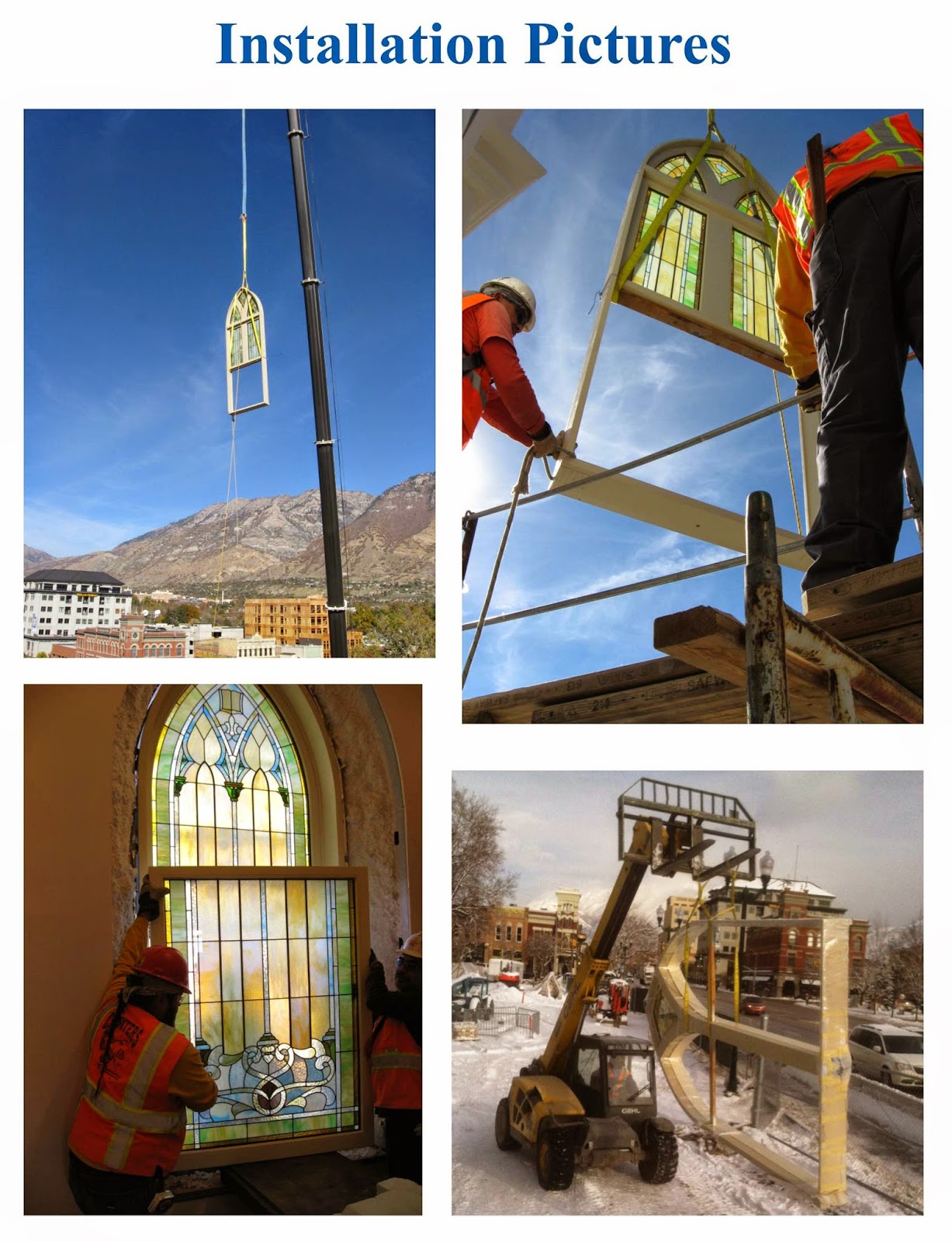
In December of 2010, the Provo Tabernacle succumbed to a fire, leaving only a masonry shell. Over the past two years the site has been under construction where the construction team excavated 40 feet below the Temple to build two levels beneath the surface. This mammoth undertaking also involves a historic restoration of the original Tabernacle.
Re-View is fabricating and installing custom mahogany windows with custom art glass for the original building. Each window has to be manufactured to fit a uniquely shaped window opening including very complex curves and angles. The laminated, insulated, art glass is extremely heavy, making some of the units weigh close to 1,000 pounds. The following pictures are of Re-View's work in our plant and in the field:


Tuesday, January 6, 2015
Reflections on 2014
As I sit at my desk during the final week of the year, I am
always amazed at how business comes to a screeching halt during the holidays. One
good thing about the receding pace of work is that it gives me time to reflect
on the business. The past year has been an exciting one for many in the
construction industry. The leading economic indicators for commercial and
residential construction are all showing steady increases. Architects are
hiring again, contractors are more optimistic, developers are taking risks, and
manufacturers are investing for the future. But just as is always the case,
there are many challenges for us in the upcoming year. Here are a few of the
things I have learned in 2014.
Make Hay While the Sun Shines
Although the construction industry is far from achieving a
high growth phase, we have been steadily moving forward for the past couple of
years. Housing starts are slowly recovering and employment in the sector has
made steady gains. The value of construction by segment reflects past growth
and points to a more predictable future. Although these statistics do not
indicate a boom year for the industry, there will be more opportunities for all
in the year ahead. What is key about this steady growth scenario is that the
players who have survived the recession are in great shape to capitalize on
stable growth. Manufacturers are much leaner, architects have pruned deadwood,
and contractors are staffed to meet current market demands. Weak competitors
have also been culled from the marketplace, making for a more promising climate
to conduct business. Now is the time to start your engines and leverage the
changes that were dealt by the great recession. Don’t miss out on the
opportunities that 2015 will bring by staying in that familiar hunkered-down
posture of the last seven years.
Don’t
Count on the Government
Maybe I have become jaded over the decades, but I have come
to the conclusion that you cannot run a business based upon what may happen in
the State or Federal government. We do a
great deal of preservation work on governmental buildings and my first-hand
view of the waste of governmental funds is nauseating. Although I have often
been the recipient of this largess, it is a shame our leaders are not better
stewards with our tax dollars. I have also had the pleasure of battling
agencies like OSHA and have seen chalk boards in their offices with targeted
penalty dollars to be assessed to local businesses. Add to that the 27 percent
increase in health care costs for our business and one can quickly lose faith.
I don’t have a solution for the fiasco; politics is just politics.
On the other side of ineptitude of governmental decision
making, our industry just received an early Christmas present from Congress. Two
weeks ago, they voted to allow businesses to depreciate up to $500,000 in
machinery/equipment purchases for 2014. This move is intended to provide
manufacturers the incentive to make investments in plant and equipment. It’s is
a good program to motivate investment to drive the economy. Unfortunately
Congress waited until the last week of the year to approve the move so it
became a windfall for companies like mine that have already made such
investments. These
days I just sit back and see what craziness comes from Washington. I’ve found
that a good strategy to employ is to take the lumps when lumps are served and take
the money and run when the wind blows your way.
Good
People are Harder to Find
One would think that given our high unemployment rate for
the past five years, it would be easy to find people who are qualified and want
to work. I haven’t found that to be the case. I believe there is a diminished
pool of talented people who want to perform the physical labor associated with
construction activity. I don’t know if
it has something to do with the millennial generation, an aging workforce, the
rise in obesity, or just a gradual degradation of our work ethic. It might have something to do with all of the
above. I like this video from Mike Rowe of the show Dirty Jobs expressing his
concern for the diminished interest in occupations requiring hard work. Regardless
of the cause, the industry is going to have to work harder at finding people
willing and able to work. In addition to spending more effort to sift through
the rank and file, we are going to have to be willing to pay more for people
who want to work and learn the trade.
Invest
in Yourself
There has been a great deal of news recently about unrest in
the United States around race, authority, and governmental responsibility. It
is time that we stop looking outside of ourselves for change. Real change
happens from within. If you invest in
yourself, your faith, your family, your friends, and your company, you will
discover the quickest route to positive change. We are becoming a country of
spectators who are waiting for someone else to lead us to satisfaction. Wealth
is not to be found in the next lottery ticket. Break this trend by becoming a
personal change agent. Take the individual responsibility to engage yourself in
personal improvement and you will see the world change around you.
Believe
in Miracles
Last October, I watched with the rest of the country as a
baseball team surprised the world with its performance in pursuit of the World
Series. The Kansas City Royals came out
of nowhere as a remote Wild Card entry to come within one game of winning it
all. They were successful by believing
the impossible was possible and by not giving credence to the naysayers. All of
a sudden a group of kids who love the game of baseball were making history. It
is time to begin believing in miracles and believing in yourself. As my teenage
daughter said, miracles are like pimples; once you look for them you find them
everywhere.
So I tip my hat to 2014 and head into 2015 with hope,
excitement, and confidence. Although our path will still be littered with challenges, there
are exciting opportunities ahead for those who are brave enough to embrace them.
Thursday, October 23, 2014
Unhealthy Insurance
For some reason, I find myself gravitating more to old Bob
Dylan music than usual. I am
particularly fond of the song, “The Times They are A-Changin’ ”.I guess I find
this song comforting as I navigate changes in the construction industry. As a
business owner, the changes in health insurance are on the top of my list.
Professionals in the construction industry are quite
familiar with how insurance affects our industry since we contend with all
types of coverage in many different aspects of the business. Coverage such as bonding, general liability,
workers compensation, OCIP, CCIP, and others are just a part of doing business. Health insurance, on the other hand, has
become a major challenge whether you are the owner of the business or the guy
swinging a hammer in the field.
Of all of the political changes that have emerged from
Washington over the past 50 years, I would have to say that the passing of the
Affordable Care Act (ACA) back in 2010 surpasses them all in creating
controversy. The new law has created discontent from rich to poor and everyone
in between because it involves significant changes for all. This post is not another bitch session on the
unconstitutionality of Affordable Care, or a politically charged diatribe. I just want to outline the challenges that
confront many of us in the construction industry.
According to the Census Bureau, 53.9% of the total
population is covered by an employer based health plan. A very high percentage of architects, general
contractors, owners, subcontractors, and union members are beneficiaries of
this type of coverage. The average cost of such health benefits is $2.70 per
hour or 8.5% of total average compensation.
So we’re talking about significant costs that will dramatically impact this
type of coverage in the future as these costs increase.
I wasn’t the only one who found the provisions in the ACA to
be complicated as it was being considered on Capitol Hill, signed into law, and
contested at the Supreme Court. The
original documents were said to be over 10,000 pages long and many people in Congress
even admitted that they didn’t fully understand its implications. The law itself is 2,409 pages long. The program went into effect on January 2014
and all of its effects on healthcare in the United States have yet to be seen.
Our company decided to grandfather our existing program back
in December 2013 so we could provide the same level of coverage to our employees
for the current year. Over the past
decade, we have become familiar with double-digit increases in health insurance
costs and have changed from one insurer to another in an attempt to purchase
the best deal available in the marketplace. We are now in a position where we
have to pay the new rates that are a result of the implementation of the ACA. Currently we are confronting a 52% increase
to renew our coverage for 2015. Yes, you
heard that correctly. Fifty-two percent!
So what’s a company that is confronting such an explosion in
overhead cost do when it already is one of the single largest line items on the
financial statement? We really only have
the following options:
- Absorb the entire increase as a company and increase our prices in the marketplace to cover the difference. This will result in our customers paying for the added cost of insurance, or will drive the company out of business if we fail to remain competitive.
- Switch to a self-insurance alternative where the company assumes the risk that our employment base will not suffer catastrophic costs. My company is in the historic window business; we are not actuarial experts who can effectively gamble on future health outcomes. We also have fewer than 30 employees, making this option highly risky.
- Change the coverage of our current plans to new plans where there are higher deductibles, increases in co-pay amounts, reductions in total coverage, and decreases in prescription coverage. These changes reduce the premiums, but effectively transfer the health costs to the employee who has to fork over more money for every procedure.
- Change the amount the company contributes to the individual and family plans. This results in lower corporate costs, but transfers increases in coverage to the employee.
- Eliminate all coverage and ask everyone to purchase their own insurance on the exchanges. Who knows what this would mean for our employees?
Our company will probably choose some combination of the
above alternatives to meet the challenge.
So in essence, the burden of the costs associated with ACA will be
shouldered jointly by the company and by our employees. This wouldn’t be an issue if the company was flush
with cash and our employees were paid like investment bankers. But that’s not the case at Re-View, nor is it
the case for most companies engaged in the construction industry.
What are you going to do?
Here is what the esteemed management consultant Bob Dylan would do:
“Come gather ‘round people wherever you roam
And admit that the waters around you have grown
And accept it that soon you’ll be drenched to the bone
If your time to you is worth savin’
Then you better start swimmin’ or you sink like a stone
For the times they are a changin’”
Thursday, September 18, 2014
I Need Some Help
I was having lunch the other day with a friend of mine who
works in one of the large law firms in town when the topic of hiring new
employees came up. Although the type of
employee one hires for a law firm is quite different from the people I hire for
our manufacturing plant, the similarities of our frustrations were
incredible. Our biggest complaint was
how difficult it is to find employees who have a passion for work. Given the fact that the unemployment rate in
the United States is around 6.2%, one would think that there are a lot of
people out there who are very hungry for employment. That has not been my experience. The biggest challenge my company faces right
now is finding good employees. This made me wonder what’s going on in this
country that is driving a general malaise in the workforce.
I tend to use a lot of sports analogies in running a
business. One of my favorites is the
example of how a successful company must attract the best people in the same
way a championship team selects the best players. It is also critically important to have the
right people in the right positions. You
won’t make it very far in the NFL by having your wide receiver play on the
offensive line. Jim Collins’ book “Good to Great” emphasizes the importance
of effective staff placement. Since the
team is of critical importance, this applies more pressure to hiring the right
people. The days of hiring based upon
whether someone can fog a mirror are gone forever.
Last year, I attended a preservation conference where RudyChristian spoke on the serious decline of people trained in the traditional
building trades. The general lack of
interest from the youth of America in the trades has caused many schools to
discontinue offering these degrees. We
experienced this phenomena 15 years ago when it became increasingly difficult
to find talented craftsmen. As a result,
Re-View began to invest in automated equipment that enabled us to manufacture
period work without relying on master carpenters for every process. These investments allowed the company to grow
despite the dearth of experienced talent.
Now we are having a major challenge just finding people who want to work
in general, never mind finding someone with experience in their trade. If the people who are protesting raising the
minimum wage to $15 applied the same amount of energy to showing up for work
and applying themselves every day, I have a $15+ job available for them right now.
This made me wonder whether we are dealing with a
generational trend. Is there something about
the psyche of the Millennial generation that contributes to my challenges in
finding people with a strong work ethic?
Millennials are defined as people in the United States who are 18 to 35
years old. William Strauss and Neil Howe
wrote several books on the Millennials and generational theory, and they state
we are in a period of generational crisis where the current generation is
demanding change. This crisis is largely
a result of 9-11, the economic downturn, and the stagnation in government. Some of the prominent traits of this
generation are a sense of entitlement and a narcissistic demeanor. Jean Twenge wrote a book about the
Millennials titled “Generation Me” where
she concluded that narcissism is markedly higher in the Millennials than previous
generations. I think I’m on to
something.
So let’s take a look at how these generational trends affect
a business. Millennials have a distrust of
the country’s institutions, which includes companies like mine. They don’t think in terms of what they can do
for the company as much as what the company can do for them. Their work is a means to engage in other
endeavors rather than as an opportunity to create a career. Millennials expect to get paid well and move
up the corporate ladder as part of the deal, not as a result of expending the
extra work to improve your ability and standing. It’s better to get something for nothing than
have to work hard to earn it. Sitting
behind a computer terminal is much more desirable than labor intensive
occupations. Instead of being lucky to
have a good job, they feel their employers are lucky to have them show up for
work. After that depressing profile, I
am starting to agree with Twenge that we are truly in a crisis right now!
Although I generalize profusely about millions of people
above, these trends are having a dramatic effect on businesses’ ability to find
people who want to work in either the trades or manufacturing. Companies are going to have to pay more and
have better benefits while they receive reduced output. There will also be fewer people in the
marketplace looking for work that involves sweating for eight hours a day. If you want someone to work on weekends or
extra hours, you had better be willing to compensate them well for the
effort. Team building consultants will
no longer be able to use the term “There is no I in the word TEAM” since the
employment base is primarily concerned with themselves. It’s a new world, baby.
I guess we baby boomers have nobody to blame but
ourselves. From the start we spoiled our
kids with lavish birthday parties, organized sports for every season, the
latest in fashion, personal automobiles, etc.
Helicopter parents were always there to swoop in and take care of any
problem no matter how big or small. Kids
were too busy in the summer with their organized activities to hold down a
job. I guess I never should have
provided trophies for the losing hockey team back when I coached because I was
just encouraging that sense of entitlement. Essentially, we got what we asked
for.
So what is a business to do?
Last week, as I dropped my daughter off at college, I told her not to
worry about the fact that her art college was 60% female and that a high
percentage of the males were gay. I told
her she was more than capable of overcoming the statistical odds if she were
serious about finding someone to date.
My advice was to embrace the challenge.
I think that advice also works for businesses that are trying to attract
talent during these challenging times.
There are good people out there.
It is just going to take more effort and a strong dose of patience to
find them.
Subscribe to:
Posts (Atom)

 Posts
Posts

