Thursday, February 19, 2015

Redefining Sustainability


My company is currently in the process of restoring over 1,600 window sash for a large historic project in Buffalo, NY. As I recently walked through our plant and saw the thousands of windows in various stages of repair, I reflected upon how we were repairing windows that are over 135 years old. This made me think about the current state of the construction industry and what our expectations are for the life of a building structure and the components that make up that structure. Over the past ten years, there has been a great deal of talk about Green Buildings and sustainability, but how many of these “Green” commercial or residential buildings are designed or constructed to last for centuries? When will the life cycle of the structure and the construction materials themselves become factors in the sustainability criteria? It seems to me that more effort is placed on whether a material is recyclable than whether it can perform over the long haul. It is time that the design community, manufacturers, and construction processes begin to consider the life of the building if we are truly going to incorporate sustainability in our industry.

Back in 1993, the U.S. Green Building Council developed the LEED green building rating system as a way to guide building owners to be environmentally accountable and to use resources responsibly. The LEED system has had a profound effect upon the design community by motivating advancements in energy efficiency, use of recyclable materials, incorporation of natural daylight, and reuse of water. The LEED program made the word “sustainability” a household term over the past ten years, but has it truly redefined sustainable design? I would submit that LEED has been most successful in motivating changes in how structures consume natural resources and how the structure can be recycled at the end of its useful life. Very little emphasis has been put on designing a structure and using component materials that will last for many generations.

I like the definition of sustainability from author and professor Geir B. Asheim. “Sustainability is defined as a requirement of our generation to manage the resource base such that the average quality of life that we ensure ourselves can potentially be shared by all future generations.” I would submit that true sustainability in the construction industry implies that we construct edifices that can be used for many generations. It does not mean that we build a structure that has to have its major components replaced every 20 years.

Take windows for example. The major window manufacturers have developed designs that require the replacement of the entire window once the insulated glass seal has failed. Although the window is made of materials that can be recycled, it isn’t designed for multi-generational, long-term use. Changes in the glazing details that would facilitate glass replacement could dramatically extend the lifespan of these products. Other manufacturers use inexpensive materials such as vinyl for major structural members that have spurious life expectancy. Ask any window manufacturer for the life expectancy of their products and they will refer to their 10 year product and 20 year glass warranties. Is it unreasonable to expect a window to last for more than 20 years? I don’t think so.

Other products such as appliances, finishes, roofing, HVAC, lighting, siding, etc. also have very limited life expectancies. Some promote lifetime warranties that are so burdened with legalese they are rendered useless.  By limiting the warranty to the original purchaser, prorating the warranty every year, and limiting exposure, the warranty actually protects the manufacturer more than the purchaser. American manufacturers have become more concerned with cutting costs than building better products. If manufacturers made changes in designs and the base materials used in fabrication, they could dramatically improve the expected years of service. Although many of the changes in materials will increase prices, there is a market for more durable products.

It’s time that the construction industry begins to take the life cycle of our new structures more seriously. We need to make advances in the quality of our construction designs and materials for the industry to truly become driven by sustainability. We should view our work as a testament for future generations rather than a disposable structure that will eventually be long forgotten.


Friday, January 23, 2015

Re-View Project Highlight: Provo City Center Temple


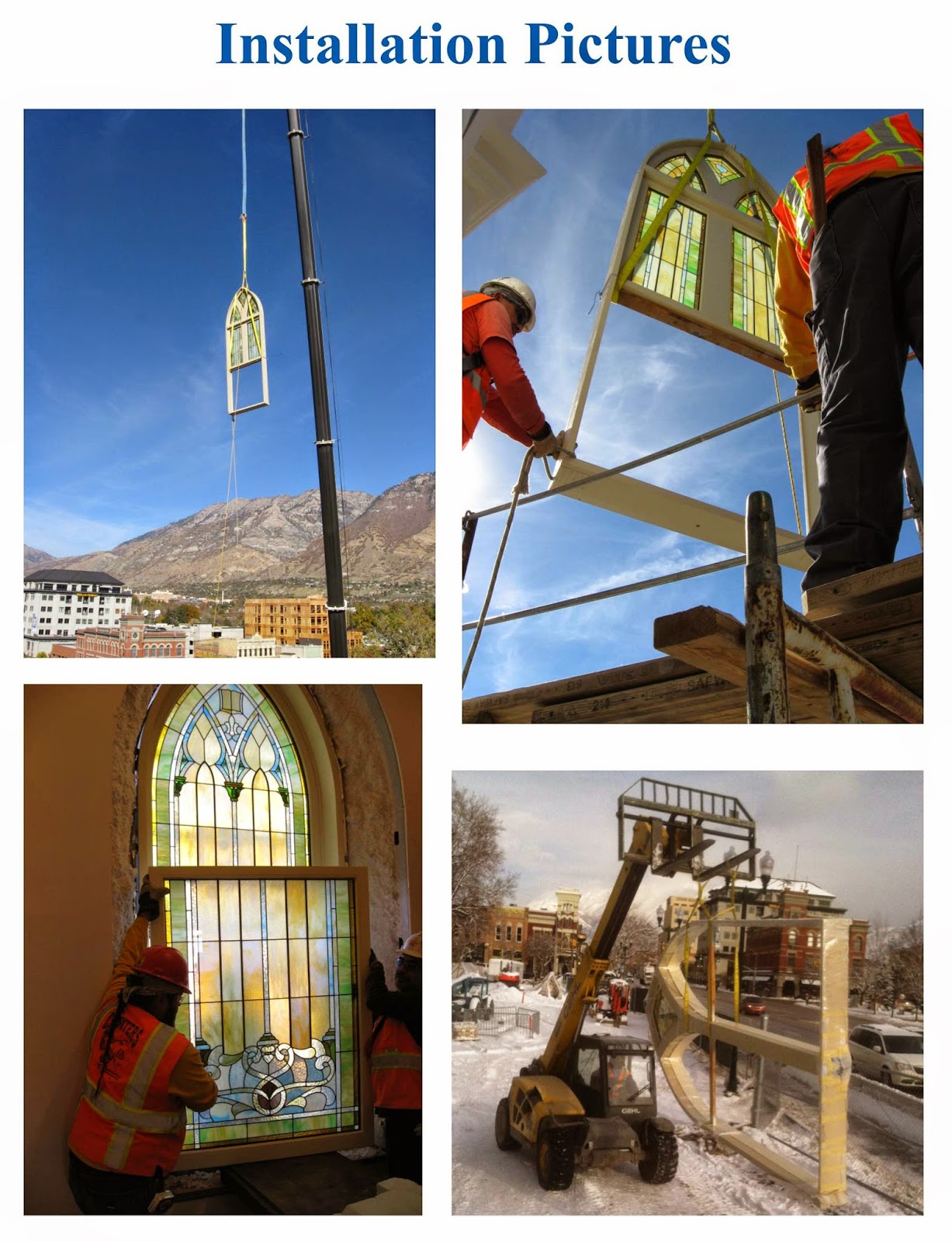
In December of 2010, the Provo Tabernacle succumbed to a fire, leaving only a masonry shell. Over the past two years the site has been under construction where the construction team excavated 40 feet below the Temple to build two levels beneath the surface. This mammoth undertaking also involves a historic restoration of the original Tabernacle.

Re-View is fabricating and installing custom mahogany windows with custom art glass for the original building. Each window has to be manufactured to fit a uniquely shaped window opening including very complex curves and angles. The laminated, insulated, art glass is extremely heavy, making some of the units weigh close to 1,000 pounds. The following pictures are of Re-View's work in our plant and in the field:


Tuesday, January 6, 2015

Reflections on 2014


As I sit at my desk during the final week of the year, I am always amazed at how business comes to a screeching halt during the holidays. One good thing about the receding pace of work is that it gives me time to reflect on the business. The past year has been an exciting one for many in the construction industry. The leading economic indicators for commercial and residential construction are all showing steady increases. Architects are hiring again, contractors are more optimistic, developers are taking risks, and manufacturers are investing for the future. But just as is always the case, there are many challenges for us in the upcoming year. Here are a few of the things I have learned in 2014.

Make Hay While the Sun Shines

Although the construction industry is far from achieving a high growth phase, we have been steadily moving forward for the past couple of years. Housing starts are slowly recovering and employment in the sector has made steady gains. The value of construction by segment reflects past growth and points to a more predictable future. Although these statistics do not indicate a boom year for the industry, there will be more opportunities for all in the year ahead. What is key about this steady growth scenario is that the players who have survived the recession are in great shape to capitalize on stable growth. Manufacturers are much leaner, architects have pruned deadwood, and contractors are staffed to meet current market demands. Weak competitors have also been culled from the marketplace, making for a more promising climate to conduct business. Now is the time to start your engines and leverage the changes that were dealt by the great recession. Don’t miss out on the opportunities that 2015 will bring by staying in that familiar hunkered-down posture of the last seven years. 

Don’t Count on the Government

Maybe I have become jaded over the decades, but I have come to the conclusion that you cannot run a business based upon what may happen in the State or Federal government.  We do a great deal of preservation work on governmental buildings and my first-hand view of the waste of governmental funds is nauseating. Although I have often been the recipient of this largess, it is a shame our leaders are not better stewards with our tax dollars. I have also had the pleasure of battling agencies like OSHA and have seen chalk boards in their offices with targeted penalty dollars to be assessed to local businesses. Add to that the 27 percent increase in health care costs for our business and one can quickly lose faith. I don’t have a solution for the fiasco; politics is just politics.

On the other side of ineptitude of governmental decision making, our industry just received an early Christmas present from Congress. Two weeks ago, they voted to allow businesses to depreciate up to $500,000 in machinery/equipment purchases for 2014. This move is intended to provide manufacturers the incentive to make investments in plant and equipment. It’s is a good program to motivate investment to drive the economy. Unfortunately Congress waited until the last week of the year to approve the move so it became a windfall for companies like mine that have already made such investments. These days I just sit back and see what craziness comes from Washington. I’ve found that a good strategy to employ is to take the lumps when lumps are served and take the money and run when the wind blows your way.

Good People are Harder to Find

One would think that given our high unemployment rate for the past five years, it would be easy to find people who are qualified and want to work. I haven’t found that to be the case. I believe there is a diminished pool of talented people who want to perform the physical labor associated with construction activity.  I don’t know if it has something to do with the millennial generation, an aging workforce, the rise in obesity, or just a gradual degradation of our work ethic.  It might have something to do with all of the above. I like this video from Mike Rowe of the show Dirty Jobs expressing his concern for the diminished interest in occupations requiring hard work. Regardless of the cause, the industry is going to have to work harder at finding people willing and able to work. In addition to spending more effort to sift through the rank and file, we are going to have to be willing to pay more for people who want to work and learn the trade.

 Invest in Yourself

There has been a great deal of news recently about unrest in the United States around race, authority, and governmental responsibility. It is time that we stop looking outside of ourselves for change. Real change happens from within.  If you invest in yourself, your faith, your family, your friends, and your company, you will discover the quickest route to positive change. We are becoming a country of spectators who are waiting for someone else to lead us to satisfaction. Wealth is not to be found in the next lottery ticket. Break this trend by becoming a personal change agent. Take the individual responsibility to engage yourself in personal improvement and you will see the world change around you.

Believe in Miracles

Last October, I watched with the rest of the country as a baseball team surprised the world with its performance in pursuit of the World Series.  The Kansas City Royals came out of nowhere as a remote Wild Card entry to come within one game of winning it all.  They were successful by believing the impossible was possible and by not giving credence to the naysayers. All of a sudden a group of kids who love the game of baseball were making history. It is time to begin believing in miracles and believing in yourself. As my teenage daughter said, miracles are like pimples; once you look for them you find them everywhere.

So I tip my hat to 2014 and head into 2015 with hope, excitement, and confidence. Although our path will still be littered with challenges, there are exciting opportunities ahead for those who are brave enough to embrace them. 


Thursday, October 23, 2014

Unhealthy Insurance


For some reason, I find myself gravitating more to old Bob Dylan music than usual.  I am particularly fond of the song, “The Times They are A-Changin’ ”.I guess I find this song comforting as I navigate changes in the construction industry. As a business owner, the changes in health insurance are on the top of my list.

Professionals in the construction industry are quite familiar with how insurance affects our industry since we contend with all types of coverage in many different aspects of the business.  Coverage such as bonding, general liability, workers compensation, OCIP, CCIP, and others are just a part of doing business.  Health insurance, on the other hand, has become a major challenge whether you are the owner of the business or the guy swinging a hammer in the field.

Of all of the political changes that have emerged from Washington over the past 50 years, I would have to say that the passing of the Affordable Care Act (ACA) back in 2010 surpasses them all in creating controversy. The new law has created discontent from rich to poor and everyone in between because it involves significant changes for all.  This post is not another bitch session on the unconstitutionality of Affordable Care, or a politically charged diatribe.  I just want to outline the challenges that confront many of us in the construction industry.

According to the Census Bureau, 53.9% of the total population is covered by an employer based health plan.  A very high percentage of architects, general contractors, owners, subcontractors, and union members are beneficiaries of this type of coverage. The average cost of such health benefits is $2.70 per hour or 8.5% of total average compensation.  So we’re talking about significant costs that will dramatically impact this type of coverage in the future as these costs increase.

I wasn’t the only one who found the provisions in the ACA to be complicated as it was being considered on Capitol Hill, signed into law, and contested at the Supreme Court.  The original documents were said to be over 10,000 pages long and many people in Congress even admitted that they didn’t fully understand its implications.  The law itself is 2,409 pages long.  The program went into effect on January 2014 and all of its effects on healthcare in the United States have yet to be seen.

Our company decided to grandfather our existing program back in December 2013 so we could provide the same level of coverage to our employees for the current year.  Over the past decade, we have become familiar with double-digit increases in health insurance costs and have changed from one insurer to another in an attempt to purchase the best deal available in the marketplace. We are now in a position where we have to pay the new rates that are a result of the implementation of the ACA.  Currently we are confronting a 52% increase to renew our coverage for 2015.  Yes, you heard that correctly.  Fifty-two percent!

So what’s a company that is confronting such an explosion in overhead cost do when it already is one of the single largest line items on the financial statement?  We really only have the following options:
  1. Absorb the entire increase as a company and increase our prices in the marketplace to cover the difference.  This will result in our customers paying for the added cost of insurance, or will drive the company out of business if we fail to remain competitive.
  2. Switch to a self-insurance alternative where the company assumes the risk that our employment base will not suffer catastrophic costs.  My company is in the historic window business; we are not actuarial experts who can effectively gamble on future health outcomes.  We also have fewer than 30 employees, making this option highly risky.
  3. Change the coverage of our current plans to new plans where there are higher deductibles, increases in co-pay amounts, reductions in total coverage, and decreases in prescription coverage.  These changes reduce the premiums, but effectively transfer the health costs to the employee who has to fork over more money for every procedure.
  4. Change the amount the company contributes to the individual and family plans.  This results in lower corporate costs, but transfers increases in coverage to the employee.
  5. Eliminate all coverage and ask everyone to purchase their own insurance on the exchanges.  Who knows what this would mean for our employees?


Our company will probably choose some combination of the above alternatives to meet the challenge.  So in essence, the burden of the costs associated with ACA will be shouldered jointly by the company and by our employees.  This wouldn’t be an issue if the company was flush with cash and our employees were paid like investment bankers.  But that’s not the case at Re-View, nor is it the case for most companies engaged in the construction industry.

What are you going to do?  Here is what the esteemed management consultant Bob Dylan would do:

“Come gather ‘round people wherever you roam
And admit that the waters around you have grown
And accept it that soon you’ll be drenched to the bone
If your time to you is worth savin’
Then you better start swimmin’ or you sink like a stone

For the times they are a changin’”

Thursday, September 18, 2014

I Need Some Help


I was having lunch the other day with a friend of mine who works in one of the large law firms in town when the topic of hiring new employees came up.  Although the type of employee one hires for a law firm is quite different from the people I hire for our manufacturing plant, the similarities of our frustrations were incredible.  Our biggest complaint was how difficult it is to find employees who have a passion for work.  Given the fact that the unemployment rate in the United States is around 6.2%, one would think that there are a lot of people out there who are very hungry for employment.  That has not been my experience.  The biggest challenge my company faces right now is finding good employees. This made me wonder what’s going on in this country that is driving a general malaise in the workforce.

I tend to use a lot of sports analogies in running a business.  One of my favorites is the example of how a successful company must attract the best people in the same way a championship team selects the best players.  It is also critically important to have the right people in the right positions.  You won’t make it very far in the NFL by having your wide receiver play on the offensive line.  Jim Collins’ book “Good to Great” emphasizes the importance of effective staff placement.  Since the team is of critical importance, this applies more pressure to hiring the right people.  The days of hiring based upon whether someone can fog a mirror are gone forever.

Last year, I attended a preservation conference where RudyChristian spoke on the serious decline of people trained in the traditional building trades.  The general lack of interest from the youth of America in the trades has caused many schools to discontinue offering these degrees.  We experienced this phenomena 15 years ago when it became increasingly difficult to find talented craftsmen.  As a result, Re-View began to invest in automated equipment that enabled us to manufacture period work without relying on master carpenters for every process.  These investments allowed the company to grow despite the dearth of experienced talent.  Now we are having a major challenge just finding people who want to work in general, never mind finding someone with experience in their trade.  If the people who are protesting raising the minimum wage to $15 applied the same amount of energy to showing up for work and applying themselves every day, I have a $15+ job available for them right now.

This made me wonder whether we are dealing with a generational trend.  Is there something about the psyche of the Millennial generation that contributes to my challenges in finding people with a strong work ethic?  Millennials are defined as people in the United States who are 18 to 35 years old.  William Strauss and Neil Howe wrote several books on the Millennials and generational theory, and they state we are in a period of generational crisis where the current generation is demanding change.  This crisis is largely a result of 9-11, the economic downturn, and the stagnation in government.  Some of the prominent traits of this generation are a sense of entitlement and a narcissistic demeanor.   Jean Twenge wrote a book about the Millennials titled “Generation Me” where she concluded that narcissism is markedly higher in the Millennials than previous generations.   I think I’m on to something.

So let’s take a look at how these generational trends affect a business.  Millennials have a distrust of the country’s institutions, which includes companies like mine.  They don’t think in terms of what they can do for the company as much as what the company can do for them.  Their work is a means to engage in other endeavors rather than as an opportunity to create a career.  Millennials expect to get paid well and move up the corporate ladder as part of the deal, not as a result of expending the extra work to improve your ability and standing.  It’s better to get something for nothing than have to work hard to earn it.  Sitting behind a computer terminal is much more desirable than labor intensive occupations.  Instead of being lucky to have a good job, they feel their employers are lucky to have them show up for work.  After that depressing profile, I am starting to agree with Twenge that we are truly in a crisis right now!

Although I generalize profusely about millions of people above, these trends are having a dramatic effect on businesses’ ability to find people who want to work in either the trades or manufacturing.  Companies are going to have to pay more and have better benefits while they receive reduced output.  There will also be fewer people in the marketplace looking for work that involves sweating for eight hours a day.  If you want someone to work on weekends or extra hours, you had better be willing to compensate them well for the effort.  Team building consultants will no longer be able to use the term “There is no I in the word TEAM” since the employment base is primarily concerned with themselves.  It’s a new world, baby.

I guess we baby boomers have nobody to blame but ourselves.  From the start we spoiled our kids with lavish birthday parties, organized sports for every season, the latest in fashion, personal automobiles, etc.  Helicopter parents were always there to swoop in and take care of any problem no matter how big or small.  Kids were too busy in the summer with their organized activities to hold down a job.  I guess I never should have provided trophies for the losing hockey team back when I coached because I was just encouraging that sense of entitlement. Essentially, we got what we asked for.


So what is a business to do?  Last week, as I dropped my daughter off at college, I told her not to worry about the fact that her art college was 60% female and that a high percentage of the males were gay.  I told her she was more than capable of overcoming the statistical odds if she were serious about finding someone to date.  My advice was to embrace the challenge.  I think that advice also works for businesses that are trying to attract talent during these challenging times.  There are good people out there.  It is just going to take more effort and a strong dose of patience to find them.


Thursday, July 17, 2014

Back to School


Over the past two years, I have enjoyed watching my daughter go through the process of selecting a college.  In addition to the typical criteria of the reputation of the school, curriculum, teacher/student ratios, and chances of employment after graduation, I was surprised to discover the extent to which the school’s facilities influenced her decision.  For example, the top school in the country in her field of study got the ax because of the lack of investment in classrooms and the cinder block 225-square-foot dormitory rooms.  Her final selection of the Savannah College of Art and Design was largely based upon the overall energy of the campus.

This made me think about the role that facilities play in the academic experience and the associated opportunities for the construction industry.  The schools that will thrive over the next 50 years will be the ones that have invested in the atmosphere of the campus.  This experience is greatly defined by the architecture.  The investment in the restoration of traditional historic structures and the development of new vibrant buildings is going to be a critical success factor for both public and private educational institutions.

I submit that the post-high school educational sector is currently at a turning point.  Schools are facing more challenges right now than ever before in history.  Tuition rates have risen 1,120% since the 1970’s and over 50% of graduates are either jobless or underemployed.  For the first time I can remember, people are seriously debating about whether a college education is worth the investment.  Add to this depressing statistic that fact that enrollment in higher education has declined over the past ten years and will remain stagnant through 2024.   These serious collegiate challenges have inspired a new documentary on America’s struggling colleges titled, “Ivory Tower ,” that was recently released.

Some might think that the best strategy under these threatening times would be to hunker down, cut faculty, and eliminate programs to survive the financial strains.  Many schools have resorted to these strategies just to stop the bleeding.  Although this strategy might provide temporary relief for the bottom line, it won’t be successful in staving off other educational competition.  The specter of online educational programs is growing by leaps and bounds.  In a study from the American Association of State Colleges and Universities, an estimated 14 percent of students are enrolled in fully online programs, while 30 percent of all college students take at least one online class.  If the bricks and mortar campuses don’t take a proactive approach to the future, they might be joining the likes of Borders Bookstores and Blockbuster.

So how does all of this affect the construction industry?  I see a big opportunity for schools, architects, and general contractors to join forces to enhance the physical environment of higher education. This can be done by restoring and re-purposing the traditional structures on campus that carry the heritage of the institution.  Landmark buildings are in need of restoration, and more modern interior amenities should be incorporated in the design.  Enhancements can also be accomplished by sensitive development of new facilities that complement or even redefine the essence of the particular community.  Although it has suffered from leaks, the Stata Center  on the MIT campus serves as a good example of innovative academic design.

Re-View is very active in the restoration of landmark buildings on college campuses.  We are currently working on projects at the College of William and Mary and HarvardUniversity.  We are manufacturing historically correct wood window replicas that exactly match the existing window systems except for the inclusion of insulated glass for energy efficiency.  These changes enable the colleges to achieve LEED designation while they respect the historic design of the buildings.  The work on the exterior of these buildings must be done very meticulously in order to restore the traditional look of the buildings.  On the interior, the building systems and layouts are being redefined to provide a more comfortable lifestyle for the college dormitory experience. 

The next decade will be challenging for colleges and universities across the country.  The winners are going to be the ones that make investments in their facilities.  It should prove to be an exciting time for the construction industry.  As my second daughter starts through the college selection process this next year, I’ll be watching to see if I detect changes being made on the campuses we visit. I’m sure the environment on the campus will play as large a part in the selection process as it did for her sister. I only hope she chooses a college that also has a strong curriculum to match..


Friday, May 30, 2014

Business is Business


When I purchased my first business back in 1990, it was a company that had been mismanaged for many years.  The financial statements had been altered for years to hide the ugly truth that the business was going down the tubes.  Top management also had engaged in inappropriate behavior with the staff.  The climate in this company was ripe for a reality show drama that could rival the Kardashians.

As I immersed myself in this culture of debauchery, I knew that the only way to climb out of this mess was to run the business with the highest level of integrity.  Now that I reflect back upon the past 24 years, I submit that the only way to run a business is according to the Golden Rule: Do unto others as you would have others do onto you.  In my mind, this means treat people with respect, support people so they can succeed, be diligent about cutting waste, and be willing to make tough decisions that are in the best interest of the entire organization.  Keep things simple and pragmatic.  And avoid the egotistical nonsense that kills many a company.

That’s why I’m so upset with one of my recent decisions.  Folks, I have officially sold out.  I have succumbed to the political machine.  I am now one of the many who have bought into an economic fraud.  My name is Brooks, and I am a scammer.

So what have I done to violate the basic tenets of good business practice?  What action could be so odious that I would feel compelled to bare my soul to the blogosphere?  What has caused me to sell out after all these good years?  Here it goes folks.  I am prepared to confess. 

I have officially committed the company to become certified by the Forest Stewardship Council.

OUCH.  That hurt.  I think it was easier for Lance Armstrong to admit he lied.  I was hoping I would receive immediate support and words of encouragement.  A Michael Sams kind of vindication; letting me know that I was really over reacting to the circumstances.  But no.  Here I sit, a newly minted scam artist, befriended by the thousands of lemmings who have bought into the FSC program in the past.  I will soon be a member of a group that uses social responsibility as a cloak to hide its economic greed.

I was forced to pursue an FSC certification since Re-View was selected to manufacture historic window replicas for a LEED gold university project.  In order to secure a precious point towards a gold standing, the project team demanded that all wood be FSC and all people who touch said wood be chain of custody certified. 

The Forest Stewardship Council (FSC) was founded in 1993 and says that its mission is to promote environmentally sound, socially beneficial and economically prosperous management of the world’s forests.  What this organization really does is spend its time manipulating the construction industry in an effort to feather its “non-profit” nest.  The pursuit of forestry certification hegemony and the associated fees is the true calling of the FSC.  Social responsibility serves only as the accelerant to drive sales and the associated profits of certifications.

The FSC spends more effort trying to shoot down competitive forestry management programs than it does to promote responsible forestry. For many years now, the FSC has viciously attacked the Sustainable Forestry Initiative (SFI) in an effort to maintain a single standard.  They have publicly attacked consumer product manufacturers who used SFI labels in their packaging.  FSC also pays dearly to sustain its standing as the only certification accepted by LEED.  If FSC was truly interested in the promotion of responsible forestry management, one would think they would encourage other certification agencies that pursue the same goal.  This pit bull attitude towards competition shows the true colors of FSC.

I have a hard time understanding how a “non-profit” organization would need to charge such exorbitant rates for its certification.  In addition to the annual fee, one has to pay to have an auditor evaluate the written procedures demanded by the organization.  Once the auditor is gone, there is no mechanism to police compliance and there have been many cases of lapses in quality standards.  In just the past year, FSC has increased its annual fee by 32.5%.  Wow!  How many non-profits increase their rates by such a grand margin?  I could retire early if my company could increase prices at the FSC rate.


Soon my company will have an eight-page document that outlines our policies and procedures on how we handle wood according to the FSC guidelines.  Why did I take this step?  Because business is business as they say.  Our company won’t have to alter any of our business practices since we already sourced our wood from responsible forests.  After we pay our auditor and the FSC fee, we will be able to proudly display the FSC logo on our products, website, and marketing materials.  We will also be able to charge more for our FSC products even though nothing has changed.  I’m not saying we will do it…but we could.  I feel so good about myself.  It has been a tough week. I think I’ll go crawl into a hole.